
It has been a while since our last blog post because we took a much deserved break from cruising to visit family and friends back home.
Any trip home means finding a place where Moonshadow can lie peacefully tied to a dock with security from storms and other things. We found a protected place at the Bocas Marina in Bocas del Toro, which is an interesting little town at the western end of the Caribbean Coast of Panama. Mike, the dockmaster, took good care of Moonshadow while we were gone, even replacing our dock power cord when it shorted out. It was nice to return to a boat with the refrigerator still going and fully charged batteries.

There's an airport at Bocas del Toro with flights to the domestic airport in Panama City. From there it's an interesting half hour taxi ride to the international airport where we caught our flight home. There are construction cranes everywhere and a LOT of building going on in Panama City. Some of the sky-scraper architecture is pretty awesome.

But HOME is what we came for.

We were so glad to spend time with family.

 |
| Sisters? Ya think? |
And friends!
 |
| High School buddies at Big Bear |
 |
| A reunion of the Virginia to Antigua Moo Crew. |
Deb told our grand kids they'd each have a whole day alone with her and to think about something they'd like to do. That didn't take long for either of them! Brandon spent his day at California Adventure (near Disneyland) doing all the scariest rides (Deb loves scary rides too).
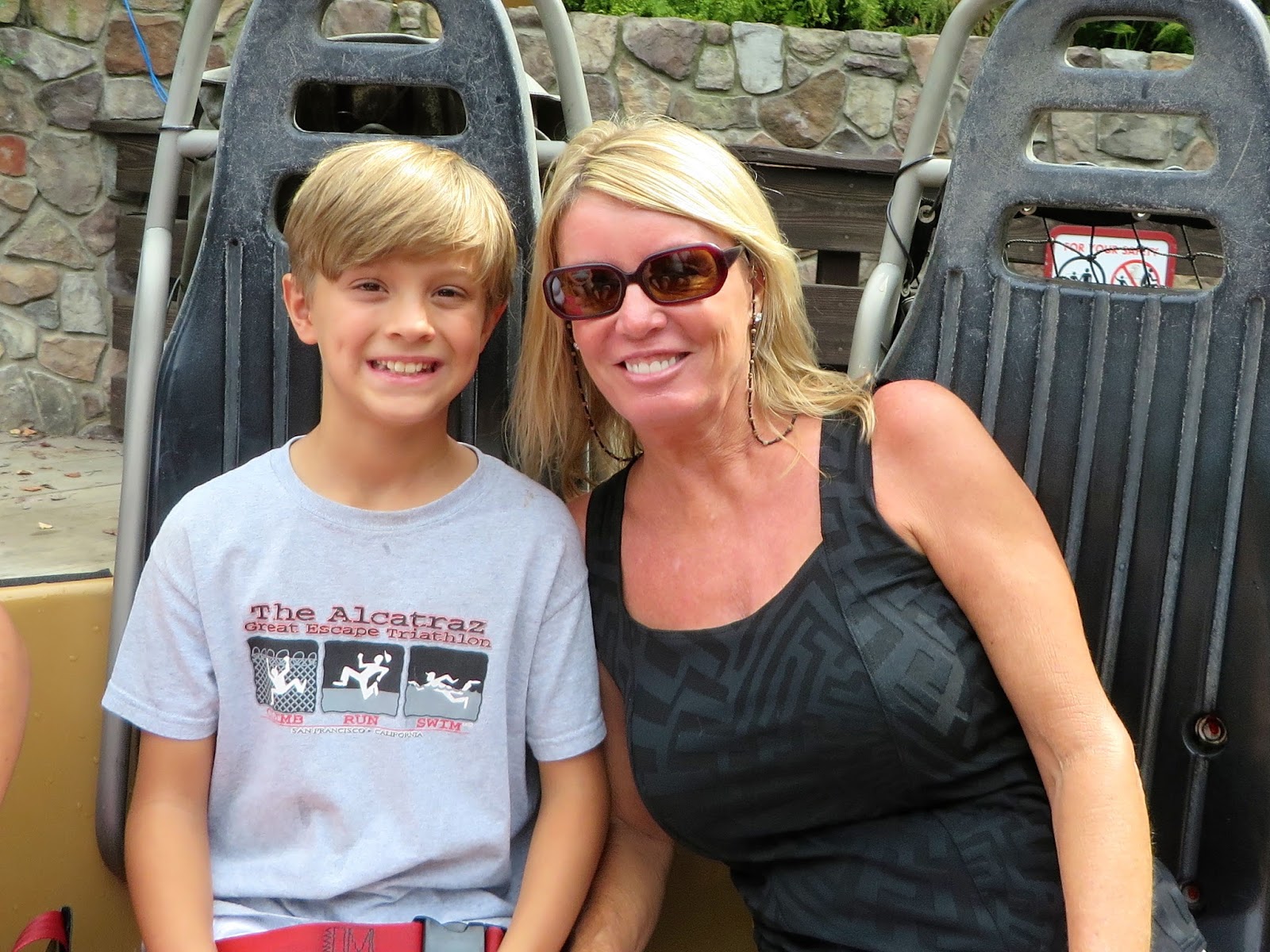
Meanwhile, Natalie spent her time first at Build a Bear where girls can build their own unique bear, Creative Cafe where Natalie made a ceramic dog, and together she and Grandma got manicures and pedicures.

Meanwhile John flew up to Grants Pass to see his father, Bill.

Summer in Oregon is so beautiful and the river flowing past Bill's house is so peaceful. The week together seemed to go by so fast and soon John and Bill were hugging goodbye.

Back in San Diego, John and Deb celebrated the fourth of July weekend with our Son and his fiance Deanna and friends Greg and Barb Darling and Moo Crew Ed and Nancy Lazarski at San Diego Yacht Club, where we enjoyed time aboard Ed and Nancy's boat Triple Pisces.

John's two weeks at home went by way too fast but his high school buddy Jamie Cooper joined him for the flight back to Moonshadow and some time in the tropics. Meanwhile Deb had more girl time planned back in San Diego.
 | |
|
The flight from Panama City to Bocas del Toro afforded a great view of the Bridge of the Americas at the Pacific side of the Panama Canal. One of these days soon, Moonshadow will take Deb and John under this bridge. That will be our first time and Moonshadow's second time through the canal.

John and Jamie were glad to finally be on the ground in Bocas.

But there was still at taxi ride to the other side of quaint Bocas Town...

...and then a water taxi to our marina.


An unexpected pleasure was our stop at Escudo de Veraguas. This is an uninhabited island of spectacular beauty. With lush vegetation growing right down to the water, the island's East end where we anchored has high sandstone cliffs and interesting coastal features.
 |
| Moonshadow was the only boat of any kind there and we enjoyed the place immensely. |
 |
| If you were a seed wanting a place to grow, you just might have to wait! |
But evidently, some of the Indians didn't read the cruising guide's description about this island being "uninhabited". These children were excited to see us and came running down to the beach to see the visitors.

But when we brought the dinghy up to the beach, they became somewhat shy. Soon enough though, we learned their names and became friends.

We may have just been lucky, but from the looks of things, this island doesn't get many visits from cruising boats.

The eastern end of Escudo de Veraguas has many small islands grouped very closely in 20-30 feet of crystal clear water.
 |
| This Mahogany tree has a good attitude. |
Next on our trip East along the Caribbean Coast of Panama, Jamie and John discovered a beautiful river. On further inspection of our cruising guide, we learned this was the Rio Chagres, first discovered by Christopher Columbus on his fourth voyage to the new world in 1503. The river is protected by the Fort San Lorenzo at it's entrance because for a time, this river was a chief Atlantic port providing access to Panama City.

Nobody fired at us from the fort as we made our way through the shoals at the river mouth but we were nearly sunk by a submerged tree of at least 40 feet. Fortunately Jamie was stationed as lookout on Moonshadow's bow and his bionic eyes found the threat just in time to suggest, in no uncertain terms, that the best outcome would follow an immediate turn to starboard. That excellent advice was followed and that made all the difference.

Rio Chagres is wide and deep. The Chagres now handles the outflow from a dam built between 1907 and 1913 to create the Gatun Lake which is part of the Panama Canal.
We anchored at a turn in the river affording beautiful views in two directions. After finishing the anchoring detail, we toasted our Bowman and his Lasik surgeon.

Further up the river we found a tributary that we followed in the dinghy.

Part way up the tributary we saw this sloth hanging from a branch over the river. These guys move really, really slowly. We figured they must not be carnivores.

Later we found a trail which eventually led through the jungle to the dam.
 |
| Captain John walked right into this guy's web! |

Along the way the beauty of the jungle trail revealed itself.
It is incredible to imagine that a 100 year old dam is still providing all the means (all the locks are powered by the gravity of falling water from the lake this dam created) to operate the world's most important conduit for maritime trade.

The view from the lake side of the dam. Beyond the dam are the locks leading North to the Caribbean Sea.

We hiked over to a viewpoint to see the canal locks. These ships are just completing their canal transit from the Pacific to the Caribbean.

From the Rio Chagres, it was on to Portobello. Deb and John had spend a night in Portobello on our San Blas to Bocas passage in June so this was a chance for Jamie to see the historical town. The forts (there are three here) are remarkably well preserved.


Another day of motor-sailing Eastward finally found Moonshadow back in Kuna Yala (San Blas).

Our first order of business was to hunt for dinner.
 |
| Hunting in Kuna Yala is easy: Give the Kuna some dollars and beer. Get lobster. |
We captured two good sized spiny lobsters, which served as dinner for the Moonshadow Crew that night. Delicious!

There's really nothing to do in Kuna Yala, but take in the raw beauty of the place, from conch shells...


to abundant beautiful and healthy coral...


 |

...these fascinating feather-worms...
(click the movie to watch the feather worm retract into it's tube)
...and FISH!


 These Lionfish (below) are not native anywhere in the Caribbean. It is thought that some of these popular aquarium fish were released in Florida back in the 1980s. They can lay up to 2 million eggs a year so now they're everywhere.
The problem is Lionfish, native to Pacific and Indian Oceans, have no natural predators in the Caribbean and their poisonous spines give them protection to freely roam as they wipe out juvenile fish, shrimp and crustaceans.
 Cruisers are encouraged to kill and eat them. They are reported to be delicious, so perhaps we'll soon give this a go.
 |
| Raining above during a snorkeling session. Beauty abounds! |
After two weeks of exploring some 220 miles of Panama's Caribbean Coast, laughing about the good old days at Point Loma High and generally doing guy stuff, Jamie and John anchored Moonshadow in Carti. This is where we waited for our Jeep trip over the Panamanian mountains to Panama City's international airport.

This Kuna woman was happy to pose for a picture... for a dollar. The story goes that when the Kuna Indians discovered their pictures on postcards that sold for a dollar, they started charging to pose for pictures.
She is wearing the full traditional garb including her "mola", the hand stitched, multi-layered reverse application panel about her midrif that Kuna are famous for. Molas are a tradition passed on over generations that started with body painting of geometric patterns and later evolved to these beautifully stitched pieces.

The two hour ride over the ridge of Panama runs through jungle so dense you couldn't walk five feet past the edge of the vegetation. At the higher elevations there are pine tree forests and elsewhere lots of evidence of lightning strikes among the twisted and tortured trees that remain.
Soon it was time to say goodbye to my good buddy. We had a great time that seemed to fly by. Jamie has a good eye for photography and took many of the photos on this blog.
By the way, all of our pictures can be enlarged by simply clicking them.
Jamie caught his flight home and Deb arrived within an hour. Then it was back to the good life! But first we stopped at the Supermarcado for Moonshadow provisions.
 |
| This Kuna Indian seems dumbstruck by the quantity of food we had. |
We are learning that our cruising life needs to include time off the boat and with the people we love. Now that we're back aboard and thinking about what's next, we realize the value in having a trip home to look forward to and returning with the memories of good times back home.
One thing is for sure:
The scenery aboard Moonshadow has certainly gotten better!


