Wednesday, May 4, 2016

Exploring the Marquesas


Waking up in the beautiful bay called Hanamoenoa on Tahuata was the perfect way to start the next chapter after making a long passage.   What could be better?


Well, one thing that made it better was the surprise email we received from friends we met in Panama three years ago saying "You'll never guess where we are... TWO miles away!!"

In no time at all, Will, Molly, Scott and Tracy of the catamaran "Yollata" were aboard Moonshadow.  Will immediately began brushing up on his conch blowing skills, while Molly helped with some body english.


Reuniting with cruising friends after so many miles have passed under our keels is such a rich aspect of the cruising life.  


After two days luxuriating in the gorgeous anchorage, we moved over to Atuona on the larger adjacent island of Hiva Oa.  It being Monday, We could now visit the authorities to check in to French Polynesia.


But first we had to negotiate Atuona's anchorage which is compressed into the shallow end of a small bay. Inter island supply ships visit here and when they do, their need for clearance to turn around results in most of the yachts becoming crammed into the last few hundred yards.  This is were we found a spot just big enough for Moonshadow's 62 foot length, and set anchors off the bow and stern so we wouldn't swing into the other boats with the shifting wind.


After a ride to the Gendarme's  office to finalize our arrival, we walked to a nearby WiFi Cafe for breakfast and our first taste of Polynesian internet access.  Let's just say the internet connection speed allows one ample time to enjoy the delicious crepes and expresso we were served for "le petit dejeuner".


As it was our first time ashore in French Polynesia, we walked around the little town of Atuona, discovering it's many charms.


We also arranged a guided tour of the island by Pifu, who has lived here all his life except when abroad in Europe and the US on a mission for his church.  It seems everybody on the island is somehow related to Pifu.


Here, Pifu is patiently teaching Mark and John the ancient Polynesian "Pig  Dance"


We nailed it!


All this was on our way to the sacred grounds of the Marquesan warriors at the Iipona archeological site on the North side of Hiva Oa.


This excellently preserved site has many of the most pristine examples of ancient Tikis and other ritual symbols, including the sites for circumcision (performed in teenage years), and tattooing, both rites of passage onto warrior status.


All this raw native stuff got us hungry so we ate at Pifu's Gramdmother's house, where she prepared and served a feast of wild boar in coconut milk, goat stew, poisson cru, tapioca fries, poached papaya, fried banana and coconut cake.


We ended the tour with a visit to the cemetery where Paul Gaugin is buried.  The famous artist is not well regarded here as the story goes that he mistreated the local women he painted.


We left Atuona for a quick trip back to the beautiful island of Tahuata where we'd originally anchored after our passage.  With friends Mark and Deanna aboard Speakeasy, the bay was even more beautiful than before.  We ended up inviting all five of the boats anchored there aboard Moonshadow for sundowners.


Next it was time to sail south to Fatu Hiva.  This was more of a motor-sail because this southern-most island in the Marquesas is also usually the most windward of the islands.  But there's no whining here, it was an easy trip...


...with amazing coastline of the southwest end of Tatuana...


...but the ultimate reward was the sight of Fatu Hiva looming up on the horizon.


This has got to be the most amazing island in the world.


Dropping the anchor in this bay is a once in a lifetime experience.


Click the video below to understand just how surreal this place is.


Behind the soccer field where the valley meets the ocean, we walked up the road looking for the trail to a waterfall.


Fortunately, our friend Mark spotted the cairns which identified the trail.


Soon we were in a deep jungle.


And, along the way, we could see the evidence of long past Marquesan tribal dwellings.


Eventually there was the 200 foot waterfall through the trees!


Very well worth the strenuous hike.


And the cool, cool water, which made some people squeal like girls...


...was actually, eventually, very welcome and refreshing.


From Fatu Hiva, we sailed Moonshadow back to Athuata where we spent time repairing our Reckmann roller furling.  


This is the apparatus that allows us to roll up the big genoa like a window shade.  The massive stainless steel bearings in this device were serviced in San Diego last summer but the bottom race un-screwed itself allowing all but ten of the ball bearings to find their way to the bottom of the Pacific Ocean.  Fortunately, our omnipresent crew member, McGiver extracted eighteen ball bearings of the exact same diameter from an old block he'd been hoarding for just such an event.  With these precious ball bearings, and some skilled handling of them that resulted in zero of them falling into the beautiful blue water, Moonshadow's crew may now continue to roll the big jib out and in.  This is big in our world.


To celebrate our latest "fixing boats in exotic places" victory, we took a walk ashore to see what this little village at Baie Vaitah was all about.


What an exquisite little village.  It seems like it must be inhabited by landscapers and gardeners because from end to end the town is beautifully manicured.  We had to imagine the beautiful voices singing within because our plans were to leave before Sunday's services.


A theme we're coming to recognize is consistent throughout the Marquesas is the islanders preference of beauty and tidiness to litter and neglect.


I mean look.  Everywhere you look you see beauty!


The thing about a 90 day visa is you gotta keep moving.  Unsure if that's a good thing or a bad thing, Moonshadow continued on through the Marquesas sailing 85 miles down island to Nuku Hiva.


The day started off with week variable winds as we motor sailed through the lee of Hiva Oa caused by easterly trade winds.  But eventually the trades established themselves and Moonshadow enjoyed the rest of the day flirting with ten knots under the A-chute.

Ua Pou's massive spires jut upward as Moonshadow glides by.
We arrived in the main anchorage of Baie du Controleur in the South-West corner of the island of Nuku Hiva.


"In the valley above this anchorage, an easy hike up a slight hill brings you to a collection of authentic Marquesan Tikis and other sacred artifacts in their natural state".

That's what I might have written in my journal forty-five years ago when I visited this very spot.  But then I was nineteen.  And I didn't keep a journal.  Now, I'm more apt to say:

"After sweating your brains out and fighting off crawling and flying insects while nursing your sore knee, if you can still see through your sweat-stained shades, you would find yourself surrounded by a bunch of stone fat guys with weeds growing through their belly".

Either way, this is worth the effort.


Back on board Moonshadow, we shifted to an anchorage called Anse Hakapaa.  This is a one boat cove.  There is coral all around the anchorage and it is deep in the middle, so by the time you let out enough scope (220 feet in our case) and add the 62' length of Moonshadow, we needed to claim a circle 550' in diameter.


To make matters more challenging, from the deck it's really hard to see where the safe, deep water ends and the coral begins.  I't probably 700 feet wide, but as you can see from the drone shot below, we nailed it.


Next it was a short motor west to Taiohae Bay. 


This is the landfall where John arrived in the Marquesas forty-five years ago.  It was fun to see again the famed limestone cross that marks the East Sentinel of the entrance to Taiohae Bay.


As the bay unfolded, John remembered how it was in 1971 entering this huge bay to find it was occupied by just one other boat, the schooner "Fairweather".  As it later turned out, John spent 4 more months living aboard and sailing Fairweather as far as the Cook Islands.


But that was then.  Today, there are close to sixty boats anchored here.  The bay could handle over a hundred yachts.  


Taking all this in, John is relieved to find that despite many obvious signs of change from his first time here, the Marquesas Islands retain the charm and the mystery that created the burning desire to return one day.


Though there is still more exploring to do here in the Marquesas, we will not likely have internet with which to post photos for who knows how long, so the rest of our Marquesan tour will follow in a later post.


Monday, April 25, 2016

Recap on the Longest Passage We'll Ever Make


All passages take on a personality unto themselves.  You remember the passage, like any other experience in life, by the unique DNA of the experience and the impressions it made on you.  So here is a look back on the memories that made our passage from Mexico to the Marquesas one we'll always remember.

What would any passage aboard Moonshadow be without a stowaway or two?  So about two days out, we noticed these Boobies (that's a kind of bird) were taking a special interest in Moonshadow.  One even decided to land on our brand new Windex masthead wind indicator, and bend it.  It was four days old at the time (the Windex - not the bird).  Then there was this guy who was determined to hang out on the bow pulpit, probably the most difficult perch a bird could find that day.  He fought every roll with wings outstretched and his webbed feet slipping and sliding until after taking several photos, John made it clear we weren't interested in any self-invited crew.  The last view of this guy was of him flying away from Moonshadow with his neck twisted around looking backward at the rude guy that evicted him.


Not far offshore from the Mexican coast the seas built to the point some of the bigger waves were quite impressive.  Enough so that we spent some time just staring aft wondering if some of the bigger ones might crash aboard Moonshadow flooding the steering cockpit.  But no, every one just slipped by under our stern, giving Moonshadow a nice little push towards the Marquesas.  And each one, no mater how big came out looking rather benign in the photos we took.


Then there were the sunsets.  It became a ritual to stop, get comfortable and just watch.

Deb decided to photograph every sunset on her iPad.

Of course there were routines we found fit into each day, including a daily shower on the stern...

 ...and the morning ritual of picking up dead flying fish and squid that thought Moonshadow was the most attractive thing ever... until they smacked onto to the deck.  This guy found a place right next to Moonshadow's name painted on the boom to end it all.

 The sky on this passage was one of the things that set it apart from all our previous voyages...

... especially at sunset... 

Now, there will always be things on a passage that are not so wonderful.  Like finding a large cotter pin on the deck 4 feet from the base of the mast.

So John spent the day taking photos of every aspect of rigging on the mast...


... and finally concluded that every clevis pin in the rigging had it's cotter pin intact. We finally agreed the pin was discarded during some work done on the boom vang in La Cruz, so ...

crisis over!

...and it was back to gazing at the Pacific sky...


 ...and wondering how many sunsets out here go completely un-noticed on an empty ocean with no ships there to see and take note.

We couldn't get enough of them...

...and if you wait just a few minutes, everything changes to a completely new scene.

Then there was the sailing.  We had some moments when the wind was too far aft for fast passage-making or completely absent.  But then there was hour after hour of sailing when it seemed Moonshadow was gleefully romping across the water, glad to be free to stretch her legs.


What a pleasure she is at times like this.  With no more than one spoke of the wheel's deflection Moonshadow would carve mile after mile in straight line headed for paradise.

 Until one day, there we were watching the GPS count down the degrees minutes and seconds 
to the equator.


Of course, all we had to do was look outside to see the green line on the water to know we had arrived exactly half way between the North and South pole.


Then it was time to celebrate:  

Shots of Mexican tequila and flutes of French Champaign were served up, a dribble on Moonshadow's bow, a splash into the Pacific for King Neptune, and the rest down our throats for a job well done.


Of course we had to dress up for the occasion, this being Deb's first time across the 00.000 line, making the transition from "Polywog" to "Shellback". 

The dreaded doldrums, an area where the wind just doesn't hardly blow at all, turned out not to be quite as windless as we'd feared, so we took advantage of every bit of wind we saw.

 Then one day we had an alarm from the auto pilot.  This happened with the spinnaker up.  The boat started to round up and nothing we did could make the autopilot regain control.  Finally while Deb hand steered, John climbed into the space where the rudder post and hydraulic auto pilot ram are located.  The problem was immediately obvious:  the hydraulic ram has a 1" stainless steel rod that threads into a stainless steel ball-joint terminal which is bolted to the rudder's auto pilot tiller.  That rod had un-screwed itself from the terminal so the auto pilot's commands to steer were not being transmitted to the rudder.  A couple of large wrenches later, all was back in place and Moonshadow was back on course for the Marquesas.  The whole episode lasted less than 15 minutes, but in that space of time there was ample opportunity for Captain and Crew to play out in their minds the prospect of hand steering for the next several days, and decide that wasn't anything we wanted to do!!


So instead we returned to gazing at the ever changing and eternally gorgeous sky and sunsets.

At sea on a long passage your are constantly reminded of millions of faces the ocean and sky can present:  Sometimes fearsome, most often indescribably beautiful, always majestic.

 Then, through the magic of GPS, we learned the day had arrived.  We would see land somewhere ahead, and we were pretty sure it would be the island of Hiva Oa.  But even without GPS, we would have known we were getting close when a huge school of dolphin arrived to escort us.  

In the picture below, we count 12 dolphin, but there were more like 80 to 100 surrounding Moonshadow as she rolled ever closer to the islands.  They were ahead, behind and on both sides of the boat, making quite a racket, jumping, splashing and exhaling, sometimes five abreast jumping clear of the water.  It went on for an hour and made us all the more excited for the awaited landfall. 

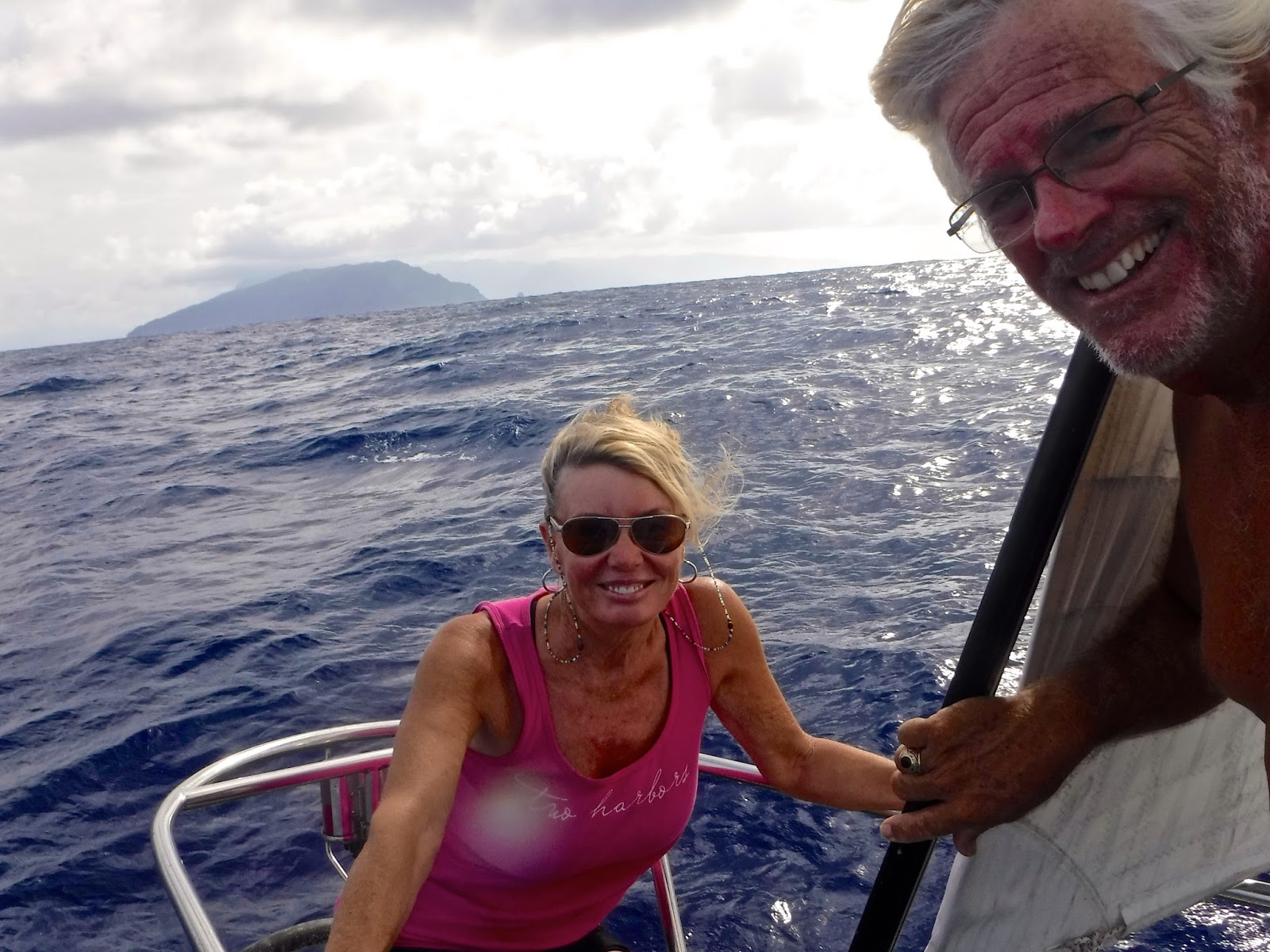
Deb saw it first:  "Land.  I see land.  No, I'm sure this time that's land!!"  Sure enough, we both described the same shape, very faintly but persistently there on the horizon.   

"Land!"  "God, don't let this be Point Loma!"

No, this wasn't Pt. Loma, it was Hiva Oa. 
The Marquesas.  
French Polynesia.

With nightfall rapidly approaching on a Friday night, we sailed past the island of Hiva Oa with it's tiny, crowded harbor at Atuana, and headed instead for a bay called Hanamoenoa on the nearby island of Tahuata where a nighttime arrival is safe.  In the pitch blackness of an overcast, moonless night, we used our Radar and GPS to slowly creep up to the cove and drop the anchor in 30 feet of water.

The next morning, we came on deck to discover what a beautiful anchorage we'd found.  


With the authorities closed till Monday, we spent the next two days relaxing napping, swimming, and basking in the realization that we'd just completed a voyage of 2800 miles in 16 days 8 hours, grateful to arrive safely aboard the good ship Moonshadow!


Monday, April 18, 2016

After 16 days on Passage, Imagine Waking Up Here

On advice from friends already in the Marquesas, we skipped entering the crowded harbor of Atuana on Hiva Oa, and anchored instead in the pitch blackness of a cloudy rainy evening about an hour after sunset at a cove called Hanamoenoa on a nearby island called Tahuata. It was easy enough to find and enter as there were no reefs or hazards at the entrance to the bay. We quickly tidied up and went to bed. This was the first time either of us was able to sleep for more than about 5 hours in two and a half weeks. It was pure luxury to wake up, and realize it was ok to roll over and go back to sleep because there was no watch to stand.


Imagine then, when the sun came up and we climbed the ladder to go on deck and look around. The cove we had anchored in was stunningly beautiful with a white beach, glistening palms, water so clear you could see the anchor on the bottom forty feet down, and fragrances coming from land that included earth, jasmine, gardenia maybe some vanilla. The image and impact of suddenly being no longer on passage, but instead anchored in such lush and beautiful surroundings will forever be the memory Deb has of arrival in the Marquesas, like the memory John has carried of his arrival here 45 years ago, which forged the dream to return one day.

A couple of cups of coffee later, reality set in. Moonshadow was still in passage mode, with spinnaker sheets, preventers, and jury rigged boom vang lines to derig, wash and stow; awnings to rig; water to make; batteries to charge; five loads of laundry to do; salt crystals on every square inch of the hull, deck and hardware to wash off; the dinghy needed to be launched from it’s blue water perch on the foredeck; the outboard winched overboard and into the dinghy. Down below, there was lots of cleaning to do and putting away of binoculars, cameras, books, flashlights, etc. that till then seemed just fine out and about, but now were just clutter. By three o’clock we realized we’d been working non stop since morning coffee, but the only thing left to do was a jump in the 89 degree Pacific, shampoo, soap suds and finally the very last thing. John shaved!

That first night on anchor was a shock to our systems which had adapted to short shifts for sleep and long hours of sailing, but the second night was the true rebirth into the realm of normalcy. We slept like the Marquesan stone Tikis and woke to yet another beautiful day in our new home: Paradise.

Dustin

How I would love to take Dustin for a sail on Moonshadow.

--

Friday, April 15, 2016

Moonshadow’s Final Passage Report


I know you call a bunch of sea animals a school, but it was a SWARM of dolphin that greeted Moonshadow to the Marquesas today. There were way too many to count, so we guessed 80 or 100 dolphin, port, starboard ahead and astern, sometimes 5 abreast jumping clear of the water. It was just a riot of splashing and exhaling dolphin, that went on for about a mile. We couldn’t imagine a better welcome party.

Landfall after a long passage is just the best. The end of one chapter and the beginning of another. A day we will never forget.

Final stats:

Distance sailed: 2837 nautical miles
Time of passage: 16 days 8 hours
Average speed: 7.2 knots
Still happily married: John and Deb

While awaiting landfall

While waiting for that moment when land looms up on the horizon and all arguments about whether it’s real or not are over, we needed something to pass the time so we showered, had a beer, and suddenly realized we were “faced” with a new delema:

The Passage Beard… keep it? lose it? give it more time?

Let us know what you think. Send us an email.

Oh, by the way. There is land right in front of Moonshadow. It this turns out to be Point Loma, we’ll never live this down!

LAND HO!!!

more pictures when we get closer.

Message from: Moonshadow

1900 zulu, April 15, 2016
09 deg. 15.7 min. South!
138 deg. 05.9 min. West
Wind East AT 17 knots
Sea conditions ENE swell 4'
Sky condition 90% blue sky

1900 zulu 24 hour distance covered: 209 nautical miles
Total distance from La Cruz: 2633 nautical miles
Total distance remaining: 56 nautical miles


WOW, this is the day we will make landfall on the island of Hiva Oa. If you squint really hard and stare at the horizon, you'd swear you can see the island. Of course you can also see giraffes and polar bears out there. Your eyes play fun tricks on you at times like this. Just 59 miles away, and featuring a mountain top over 3000 feet high, you'd think we could see it, but not yet. It is just too hazy. But soon! We are totally stoked.

Of course, from experience we know that once we do see the island it will take FOREVER to catch up to it. It usually seems like some tug boat has your landfall under tow away from you. But the way things are going, by sunset we will have finally reached the town of Atuana on Hiva Oa, completing the passage in 16 days, 7 or so hours (ever so slightly faster than the last time Moonshadow sailed here - but we're not really racing). We will continue past rounding the corner of the much smaller island of Tahuata then pull into a cove called Hanamoenoa for the night.

So. Tonight we will be swinging on an anchor in a cove that everyone says is just beautiful, with a white sand beach, crystal clear water in the high 80s and a palm plantation in the valley beyond with rugged mountains behind that, toasting the end of the longest passage of our lives past and future.

Quite a day aboard Moonshadow.

Cheers from Moonshadow

John and Deb

--